

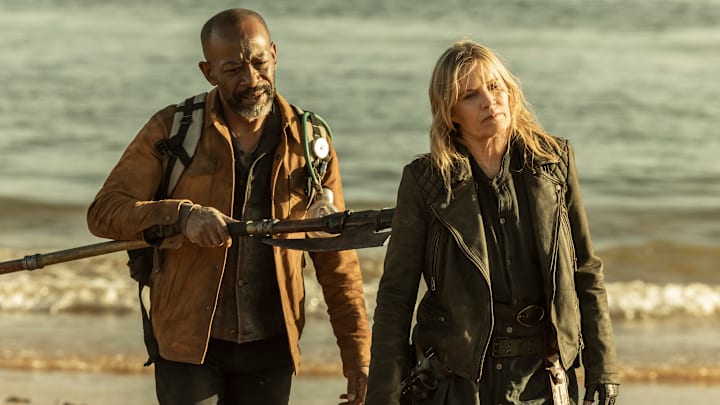
The Walking Dead Universe and spinoffs go hand-in-hand today, with the AMC franchise's very existence relying on a multitude of spinoff sequels, but way back when The Walking Dead itself was on the air, it made history by launching its first ever spinoff. And we mean history, for Fear The Walking Dead dove into the lore of this zombie apocalypse, showcasing what it was like for those living through the beginnings of it - long before Rick Grimes returned to the land of the living.
Madison and Travis Clark led their family through the harsh new realities before a controversial time-jump brought TWD's own Morgan Jones into the fray, making him one of the new leads of the show from season 4 onwards. Through ups and downs, Fear enjoyed a lengthy eight-season run - making it the only TWD spinoff to come close to matching the 11-season run of the original series.
While there was a lot of fanfare about The Walking Dead ending in 2022 (with a year-long build up to the conclusion), Fear's conclusion was relatively subdued - with the final season announcement catching fans off-guard. So, why did it all go down that way, and why did that ninth season never happen?
The beginning of the new TWD era meant the end of the old one
The conclusion of The Walking Dead may have meant the end of an era for television but it was only the beginning of a new one for the TWD Universe. Having already launched three spinoffs in Fear, World Beyond, and Tales of the Walking Dead, the franchise was no stranger to telling stories outside of the ones that involved the primary TWD characters. But once the show concluded, it was time to launch new spinoffs that would involve those characters, continuing their stories beyond the realm of the original series.
With that, Dead City would reunite longtime enemies Maggie and Negan in New York City, Daryl Dixon would take besties Daryl and Carol to France (and then the UK and Spain), and The Ones Who Live would bring Rick Grimes and Michonne back for one last hurrah so that they could showcase the end of their love story. Simply put: TWD's new spinoff era was all about The Walking Dead.

With the exception of Morgan and Dwight, Fear The Walking Dead was all about expanding the franchise beyond these characters. That unfortunately made it irrelevant to the new chapter, which was solely designed to function off of cinematic spectacles spotlighting classic TWD characters that relied on fewer episodes. Fear was designed as part of the television era, featuring larger episode counts, and was it already eight seasons in. That may not have appealed to viewers of the sleek, new, easily digestible and streaming-friendly offshoots.
Although it did get to be a part of the post-TWD era for that chapter's first annual TV season - swapping places with new shows Dead City and Daryl Dixon whenever they completed their respective seasons - it was time for the other aged warrior in the TWD Universe to conclude. It had had a long run and existed as a product of the franchise's former era at a time when it was trying to launch a new one.
Although we wish Fear could have stuck around for longer (albeit in its original incarnation), the decision to end it made sense given the new chapter that the TWD Universe was about to explore.
Fear The Walking Dead never recovered from the controversial soft reboot
As much as it pains me to say it: Fear The Walking Dead ran too long in its secondary form. Although the show took a little bit to find its footing in the beginning, it was widely considered a gripping prequel to the world of The Walking Dead, offering up new stories, interesting characters, and equally edge-of-seat dilemmas. By the time that it reached its third season, many considered it to be better than the original series, which had begun to plateau at this point. And then the awful decision was made to replace Dave Erickson as showrunner, jump forward years to catch the timeline up to TWD and introduce Morgan Jones as a full-time character.
While Morgan was an alluring element of the original series early on, overexposure to the character in the later seasons (along with repetitive storylines) made fans grow weary of him pretty quickly. Moving him to Fear was the worst thing that could have happened to it because the spinoff was in its prime shortly before this happened. To blatantly disregard the original vision - which, again, had peaked with season 3 - and replace Madison as the lead with the tired Morgan was nothing short of disrespectful on the show's part. And fans quickly made their voices heard, as the ratings plummeted (despite an early increase at the beginning of season 4) and critics panned the subsequent seasons.

If Morgan had joined Fear in a supporting role, perhaps it could have been salvaged. But not only did the new creative team "kill off" Madison, they brought in a host of new and uninteresting characters who actively stole the spotlight from the show's original characters (like Alicia Clark, Victor Strand, and Daniel Salazar). And the new creative direction ultimately resulted in the fifth and seventh seasons being regarded as two of the worst seasons in the entire TWD franchise. Even reversing-course and bringing Madison back couldn't undo the damage.
By the time that Fear The Walking Dead ended with its eighth season, its aura was gone. Widely criticized for nonsensical plots and Morgan-heavy monologues, some outlets even referred to it as one of the worst shows on television. Heck, TVLine even called it one of the worst spinoffs of all time. Needless to say, had the original creative team stayed on and the show remained focused on Kim Dickens' Madison Clark, that wouldn't have been the case.
Bringing Madison back brought the show full-circle
No matter what the posters for the fifth, sixth or seventh seasons try to tell you: Fear The Walking Dead was the story of Madison Clark and her family. Kim Dickens was the heart and soul of the show, which is why it felt so lifeless when Madison was seemingly killed off halfway through season 4, with the standard immediately declining in the second half. And yet, fans never gave up hoping that she would return.

Ahead of the revelation that Fear would end with season 8, it was confirmed that Dickens would return to the role in the back-end of season 7 before rejoining the show as a series regular for the eighth season. And then came the announcement that the eighth installment would also serve as the final season.
Whether or not showrunners Andrew Chambliss and Ian Goldberg had always planned to bring Madison back is up for debate, but the fact that they ultimately did was an admission that a mistake had been made. Dickens' gravitas as a performer grounded the show and really set it apart from its predecessor - it lost that when Madison was seemingly killed off. Therefore, it was only fitting that she return for the final season.
While Fear still struggled towards the end of its run, seeing Madison on-screens again was a reminder that at least one of the major wrongs in the show's run had been righted. And it was the biggest one of all. Fear The Walking Dead is Madison Clark's story; it was only right that she be there at the end. And that allowed the show to bow out with a natural conclusion worthy of Fear's original premise.
 Add us as a preferred source on Google