

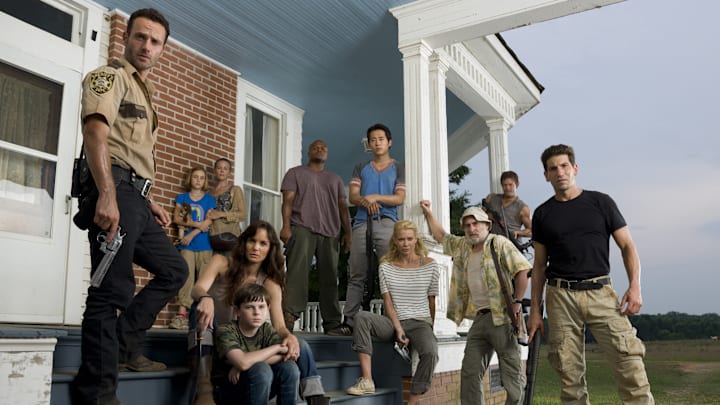
For years, The Walking Dead has been one of the defining forces in modern zombie storytelling. Its character-driven approach and slow-burn tension helped reshape the genre for television. But while the series excels in many areas, there’s one place where it consistently pulls back: large-scale, high-intensity action. That’s exactly where Peninsula charges ahead, and ultimately outdoes it.
Peninsula is a 2020 Korean zombie movie that serves as a sequel to Train to Busan. The story picks up four years after the initial outbreak, with South Korea completely overrun by the infected and quarantined from the rest of the world. The film follows Han Jung-seok (Gang Dong-won), a former Marine Corps officer who escaped the initial outbreak but is haunted by the deaths of his sister and young nephew.
Now living in Hong Kong as a refugee, he and his brother-in-law, Chul-min (Kim Do-yoon), are recruited for a high-risk mission. That's to return to the zombie-infested peninsula to retrieve a truck carrying $20 million. It’s a near-suicide mission, but the lure of money is too strong to resist. Once back in South Korea, the pair quickly realizes the peninsula is more dangerous than they expected.

A bigger, louder apocalypse
One of the most immediate differences between the two is scale. The Walking Dead often keeps its focus intimate, centering on small groups of survivors navigating isolated communities. That grounded approach works in its favor emotionally, but it can make the apocalypse feel contained.
Peninsula, on the other hand, opens everything up. Set in a completely overrun South Korea, the film presents a world that feels truly collapsed. Abandoned cities, sprawling highways, and endless hordes of the infected create a sense of scale and devastation that goes far beyond what a television budget typically allows. The result is an apocalypse that feels not just dangerous, but overwhelming.
Action that doesn’t hold back
Where The Walking Dead builds tension through silence and character conflict, Peninsula leans into adrenaline. The film is packed with high-speed car chases through zombie-infested streets, chaotic shootouts, and large-scale set pieces that rarely give the audience a moment to breathe. It’s not just action for the sake of it. It’s action that fully embraces the possibilities of the genre.
In contrast, The Walking Dead often uses zombies as a lingering threat rather than an immediate one. Over time, the walkers become part of the background, with human conflicts taking center stage. While that shift adds depth, it also reduces the raw intensity that defined the show’s earlier seasons. Peninsula brings that intensity roaring back.
Faster pacing, higher stakes
Another key advantage Peninsula has is pacing. The film moves quickly, constantly escalating danger and pushing its characters into new, increasingly desperate situations. There’s a sense of urgency in nearly every scene.
Meanwhile, The Walking Dead is known for its slower storytelling. Long character arcs and extended plotlines allow for deep development, but they can also lead to stretches where momentum stalls. Peninsula doesn’t have that luxury, and it benefits from it. The story is tight, focused, and driven by immediate survival, which keeps the tension consistently high.
A true cinematic experience
Overall, Peninsula feels like a blockbuster. Its visual style, large-scale action, and dynamic set pieces are designed for the big screen. Every sequence is crafted to feel intense and immersive. Viewers really feel as if they're being pulled directly into the chaos.
The Walking Dead, by comparison, is inherently limited by its format. Even at its most ambitious, it still operates within the constraints of episodic television. That doesn’t make it worse overall, but it does mean it can’t always compete in terms of spectacle. And spectacle is exactly where Peninsula thrives.
None of this takes away from what The Walking Dead does well. Its characters, emotional storytelling, and exploration of human morality remain some of the strongest in the genre. But when it comes to pure zombie action, Peninsula clearly has the edge.
It’s not trying to replicate what The Walking Dead does. Instead, it amplifies a different side of the zombie genre. We're talking one that’s louder, faster, and impossible to ignore. And in that one key way, Peninsula doesn’t just compete. It outdoes it.
Peninsula is available to stream on Netflix right now.
 Add us as a preferred source on Google