

Television history is filled with shocking twists, but few shows have built an identity around the phrase "no one is safe" quite like The Walking Dead. For over a decade, the zombie epic thrived on unpredictability. We watched beloved characters be torn from the story in the blink of an eye, leaders fall, families shatter, and survivors carry the physical and emotional scars of a world that never stopped punishing them. Simply, the zombie series embraced danger.
And nowhere was that philosophy more brutally realized than in the season 7 premiere. As a Walking Dead fan, it’s hard not to feel your stomach drop just thinking about that episode. The lineup scene instantly became one of the most infamous sequences in modern television. It was tense, drawn out, and unrelenting.
Negan’s (Jeffrey Dean Morgan) arrival changed the tone of the series overnight, introducing a villain who weaponized fear with chilling precision. Every pause felt deliberate, and every word spoken from Negan's lips dripped with menace. And when the violence finally came, it was devastating enough to fracture the fandom.
For many viewers, that scene marked a point of no return. But as brutal as the premiere was, it almost delivered an even more irreversible consequence. A consequence that would have permanently altered the fate of one of the show’s most beloved characters.

If you recall from the season 7 premiere, Negan kills Abraham (Michael Cudlitz) first and then gives another brief speech before Daryl (Norman Reedus) lunges at him and punches him in the face. Negan's men pull Daryl back and are ready to kill him, but Negan stops them.
Instead of executing him on the spot, Negan decides to make an example out of someone else. In a chilling display of control, Negan turns his wrath onto Glenn (Steven Yeun), delivering a punishment meant to remind the group exactly who holds the power. The only two characters to be killed in this scene are Abraham and Glenn.
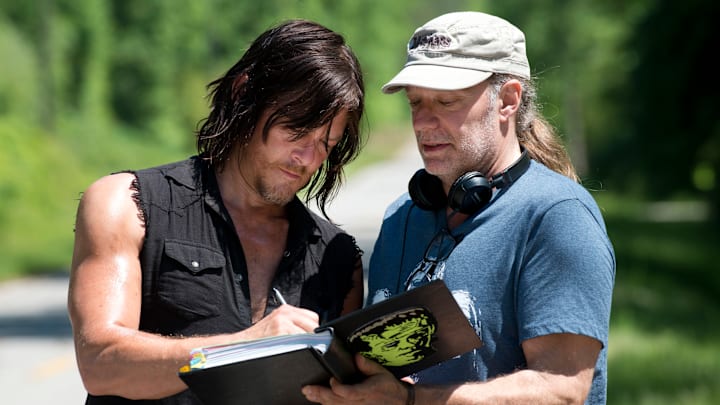
That’s the version of events burned into television history. But behind the scenes, there was once talk of pushing Negan’s retaliation even further. In a new episode of The Brandon Davis Show, The Walking Dead director Greg Nicotero revealed that in the original script, Negan was to chop off Daryl’s hand the morning after the brutal deaths of Glenn and Abraham. He told Davis that it was supposed to be Negan's "last test" for Rick's group, and because of Daryl's "rebellious" nature, he was the chosen target.
Nicotero then explained that the creative team had gone all out. They had designed a rig for Reedus, developed numerous concepts and designs, and even pitched the idea to AMC. However, the network ultimately decided they couldn’t have Daryl continue the show with just one arm because he was simply too important of a character. Nicotero then continued by saying that they ended up adapting the rig they made for Daryl and gave it to the Aaron (Ross Marquand) character.
Honestly, I personally think AMC made the right call. To take away Daryl's hand would have been a shocking narrative twist, yes, but it also could have fundamentally changed his character arc and the overall direction of the show. By redirecting the rig to Aaron, the team was still able to use their creative designs and technical innovation without permanently crippling one of the series’ most adored characters.
The Walking Dead can be streamed on Netflix.
 Add us as a preferred source on Google