

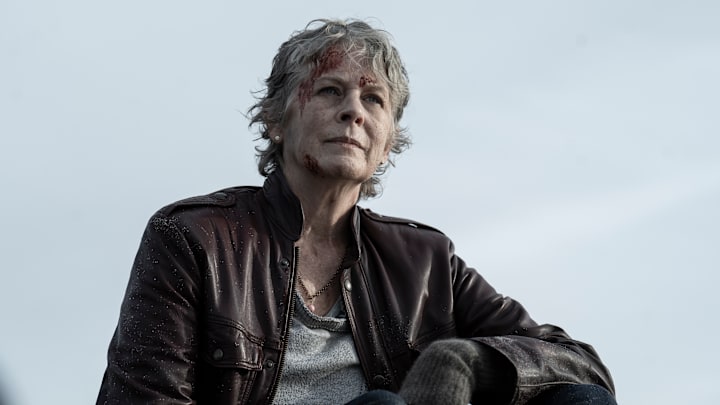
When fans think of Carol Peletier in The Walking Dead, they usually picture one of the show’s most resilient and formidable survivors. You likely think of a quiet but deadly strategist who evolved into a fan-favorite powerhouse.
But if you only know Carol from the show, you’re missing a huge part of the story. Because in the original Walking Dead comics, Carol’s journey is far more tragic, and it ends in a way that still shocks readers to this day. The truth is, Carol wasn’t always meant to be a survivor.

A much darker beginning in the comics
In the comics, Carol is introduced as a deeply vulnerable and emotionally fragile character. From the very beginning, she struggles to cope with the harsh realities of the apocalypse. Unlike her TV counterpart, who gradually builds strength and independence, comic Carol is heavily dependent on others for emotional stability.
After the collapse of society, she forms a relationship with Tyreese, clinging to him as a source of safety and validation. But when Tyreese begins a relationship with Michonne, Carol’s already fragile mental state starts to unravel. The betrayal hits her hard, triggering a downward spiral that only worsens as the group continues to face loss, fear, and constant danger.
Her behavior becomes increasingly erratic. At one point, she proposes the idea of a polyamorous relationship to Rick Grimes and his partner. It's a moment that underscores just how desperate she is for connection and belonging. Rather than being portrayed as empowering or progressive, the moment is framed as a sign of her instability and emotional distress.
The tragic ending most fans never saw
Carol’s story in the comics reaches a devastating conclusion in Issue #42. Unable to cope with her loneliness and the emotional toll of the apocalypse, she makes a chilling decision. She willingly allows a walker to bite her.
It’s one of the most disturbing moments in the entire comic series, not just because of what happens, but because of how it happens. Carol approaches the walker almost as if it were a companion, speaking to it in a way that reveals just how isolated and broken she has become. It’s less about fear and more about surrender.
After she turns, Andrea is forced to put her down, bringing Carol’s short and tragic journey to an end. Her death isn’t heroic, nor is it redemptive. It’s a stark, painful reminder that not everyone can survive the apocalypse. It's not because they aren’t physically strong enough, but because they can’t endure it mentally.
How the show completely reinvented Carol
In contrast, the television version of Carol, brought to life by Melissa McBride, takes a radically different path. While she begins in a similarly vulnerable place, particularly in her abusive relationship with Ed Peletier, the show uses that foundation as a launching point for one of the most compelling character evolutions in the series.
Instead of breaking under pressure, Carol adapts. Over time, she transforms into a survivor who is not only capable but often one step ahead of everyone else. She becomes a protector, a strategist, and at times, a morally complex figure willing to make difficult decisions for the greater good.
From her shocking actions at Terminus to her role in major conflicts against groups like the Saviors and the Whisperers, Carol proves again and again that she’s one of the toughest characters in the series. By the end of the show, she isn’t just surviving. She’s thriving in a world that once threatened to consume her.
Why the change matters
The decision to completely rewrite Carol’s arc wasn’t accidental. It reflects a broader difference in storytelling between the comics and the TV series.
The comics often lean into the brutal realism of the apocalypse, emphasizing that survival isn’t guaranteed and that emotional trauma can be just as deadly as any walker. Carol’s fate is a clear example of that philosophy. She represents the people who simply can’t endure the psychological weight of the new world.
The show, on the other hand, places more emphasis on transformation and resilience. Carol becomes a symbol of what it means to evolve, to take pain and turn it into strength. Her journey resonates with audiences because it feels empowering. She’s proof that even the most broken beginnings don’t have to define the ending.
The legacy of two very different Carols
Looking back, it’s almost hard to believe these two versions of Carol share the same origin. One is a tragic figure whose story ends in despair, while the other becomes a defining character of the entire franchise. And yet, that contrast is exactly what makes her so fascinating.
For longtime fans, revisiting Carol’s comic storyline can be shocking, especially if they were first introduced to her through the show. It’s a reminder of just how much The Walking Dead was willing to change, and how those changes helped shape some of its most memorable characters.
In many ways, Carol’s transformation represents the best of what adaptation can do. By taking a character who once symbolized vulnerability and rewriting her into a symbol of strength, the series didn’t just improve her story. It created a legacy that continues to resonate with fans long after the apocalypse first began.
You can continue to watch Carol take on walkers and various human threats while journeying across Europe with Daryl in The Walking Dead: Daryl Dixon. The highly anticipated fourth and final season is set to premiere on AMC sometime in 2026. Stay tuned to Undead Walking for more details!
 Add us as a preferred source on Google