

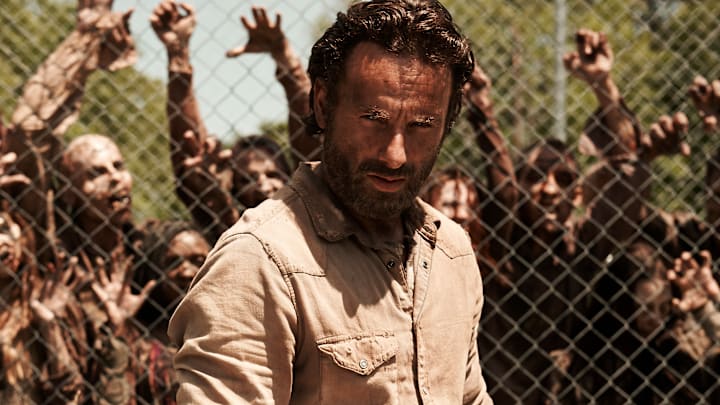
When it comes to zombies on the small screen, the conversation starts and ends with The Walking Dead. The legendary TV show brought one of the most iconic genres of horror movie to television in 2010, bringing Robert Kirkman's acclaimed comic book there at the same time. And it started a movement that led to more terrifying post-apocalyptic shows, full of the undead nightmares - including six TWD spinoffs, ensuring that its own legacy carried on beyond the original series.
That being said, while you will see all kinds of zombies in the TWD Universe, one thing you will never hear them called is, well, zombies. The franchise primarily refers to them as "walkers", specifically because The Walking Dead's main character, Rick Grimes, calls them that. Most of his allies have adopted that term, with the characters of spinoffs such as Dead City and Daryl Dixon continuing to use it years later. And here's why the show created its own term for the creatures instead of using the obvious one.
Zombie lore doesn't exist in The Walking Dead Universe
The use of the word "walker" got so popularized because of The Walking Dead, but it wasn't the only term that the survivors used to describe the flesh-eating monsters they encountered on the roads. Across the shows, they were also referred to as the likes of "biters", "empties", and more. And this naturally led fans to wonder why the survivors didn't just call the undead the obvious: Zombies.
It turns out that this was, of course, a very intentional decision from series creator Robert Kirkman, who wanted the idea of the dead rising to be so alien to humanity in this franchise that the term simply didn't exist in this universe. In an interview with Conan O'Brien, he revealed that he didn't want the survivors in the TWD world to be able to pull from zombie lore for ideas on how to deal with the outbreaks and hordes; it had to happen naturally, they had to learn as they went along.
“Zombie lore is very popular and we wanted to avoid the notion of, ‘hey, why isn’t that character just shooting that zombie in the head because of all those movies I saw?’ We wanted to give you a sense that The Walking Dead takes place in a universe where zombie fiction doesn’t exist.”

On that front, it certainly makes sense. After all, it's common knowledge that you always try to go for the zombies' heads. Granted, some adaptations of zombie lore are different but in a world in which the walkers stick pretty strictly to the typical zombie format, the creative team didn't want them having that vast well of knowledge to pull from.
And thus, zombies became walkers - which has, in actual fact, become an entity in and of itself. It's somewhat ironic because in the comics, walkers is only one of the terms used to described the creatures and it is primarily used by the survivors in the Alexandria Safe-Zone complex. The characters in the comics also used other terms frequently, particularly roamers, but they weren't afraid to say zombie every once in a while either. But, again, that wasn't an option for the TV show as Kirkman and the creative team wanted to avoid the term altogether.
Walkers was the primary name in the TWD Universe (but it wasn't the only one)
While it was easy enough to believe that walkers became the accepted term for the main characters in AMC's The Walking Dead simply because Rick was their leader (and therefore they were influenced by his terms), the show did eventually begin using other terms for specific settlements and survivors the bigger that its world got. The Governor, who was introduced in season 3, used the word Biters to describe them (and as the leader of Woodbury, his community called them that too. The Alexandrians referred to them as Roamers before Rick's group showed up, while the people in Grady Memorial Hospital called them Rotters. Abraham, Rosita, and Eugene briefly referred to them as The Dead Ones while the Whisperers called them the Guardians as they believed they protected them.

Walkers eventually made it onto Fear The Walking Dead due to characters like Morgan, Dwight, and Sherry crossing over onto the spinoff, but that wasn't the only term used there. Originally, they were simply known as The Infected due to Fear being a prequel, which told the origins of the outbreak. As the show went on and the survivors ran into different groups, terms such as Los Muertos (Spanish for "The Dead"), Eaters, and The Wasted were used temporarily. John Dorie tended to refer to them as The Passed.
World Beyond, which focused on the next generation of survivors, mostly used the term Empties. Daryl Dixon, which took its titular character (and his best friend Carol Peletier) to France, referred to them as Les Affamés (French for "The Hungry Ones") while Burners was reserved for a very specific variant with acidic blood. And Dead City, which takes Maggie and Negan to Manhattan, has its characters primarily use Groaners - a term also initially used by Fear, which it eventually moved away from.
So, there you have it, seven TWD shows and not a single use of the word zombie. While it might seem controversial to ignore the obvious term, you can't deny that the TWD Universe made it work. Robert Kirkman and the original Walking Dead team made a decision over a decade and a half ago and, boy have they managed to stick to it. And, in doing so, they have created a whole generation of zombie fans who will always refer to the walking nightmares as, simply, walkers.
 Add us as a preferred source on Google